- Your district
- Hazards
- Be prepared for anything
- Emergency Management Southland
Dramatic and ever-changing, Piopiotahi Milford Sound is one of the world's most spectacular and special environments. Its steep, glacier-carved mountains and deep fiord have been shaped by powerful geological forces over millions of years.
The area is exposed to risk from a range of natural hazards. These can occur at any time, and some can happen without warning. Of all the hazards, large earthquakes, landslides and tsunamis pose the greatest risk to people at Piopiotahi Milford Sound.
It is extremely unlikely that one will happen during your visit, especially for a short stay. However, there is a risk and the longer you spend there, the higher it becomes. Once you are there, your safety options are limited and it is important you understand the risks, before you go.
Like the rest of Aotearoa New Zealand, small earthquakes occur regularly in Fiordland. We don't feel most of them. These small movements are a normal part of how the land works and do not pose a risk to people.
Sometimes, earthquakes in or near Fiordland are felt at Piopiotahi Milford Sound. They might shake objects on a shelf or rattle a window, but they do not cause major impacts or disrupt your visit.
Occasionally, a stronger earthquake can trigger avalanches, rockfall or landslides. These can cause debris to fall onto roads, jetties and tracks, and may disrupt your travel plans if you happen to be nearby.
Large earthquakes are rare, but research tells us they will happen again. The Alpine Fault runs almost the entire length of the South Island and crosses the entrance to Piopiotahi Milford Sound. It can generate earthquakes of magnitude 8 or greater, occurring on average every 300 years. There is a 75% chance of this happening in the next 50 years (find out more at af8.org.nz). An earthquake of this size would almost certainly affect the narrow waterway and surrounding area.
What to do in an earthquake:
The steep mountains around Piopiotahi Milford Sound are prone to rockfall and landslides. Earthquakes and severe weather can make the cliffs unstable, sending rock and debris down at speed.
Smaller rockfalls are common but often go unnoticed, unless you are nearby when they occur.
Bigger landslides do not happen often. The chance of one occurring during a short visit is extremely unlikely. However, they could cause a tsunami in the fiord and do pose a risk to life at Piopiotahi Milford Sound.
Large earthquakes are the most common trigger of big landslides in Fiordland. A large earthquake during your visit is extremely unlikely, especially for a short stay.
Be prepared for landslides
Like all of Aotearoa New Zealand’s coastline, Piopiotahi Milford Sound is at risk of tsunami from multiple sources.
The most common threat comes from distant earthquakes in the Pacific Ocean. These ocean-source tsunamis take hours to reach our shores. Official warnings are issued in time for people to move to safety.
Less common, but of more concern, is the potential for a large landslide to fall into the fiord and trigger a tsunami.
Landslide-triggered tsunamis are rare. The chance of one occurring during your visit is extremely unlikely. However, they can create large waves and do pose a risk to life at Piopiotahi Milford Sound.
Be prepared for tsunamis
A recording of the presentation shared at the Queenstown workshop on 20 April 2026.
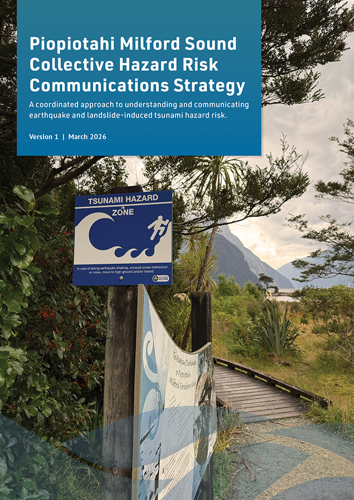
This strategy aims to ensure that visitors and workers at Piopiotahi Milford Sound are aware of the area’s natural hazards, understand that there is a risk to life when on-site, know where to find more information, and can make informed decisions about their visit — before they travel and while they are there.
It includes recommendations to support operators, agents, businesses and organisations to communicate consistent risk messaging, while recognising that implementation remains the responsibility of individual organisations.
Acknowledgements
This Collective Hazard Risk Communication Strategy has been co-developed by Emergency Management Southland, Department of Conservation, Milford Sound Tourism Ltd., Te Ao Marama Inc., Tourism New Zealand, Great South, Southern Discoveries, Real NZ, the AF8 Programme, and the National Emergency Management Agency. It is based on advice from GNS Science (now ESNZ), commissioned in 2024.